
Buying a new chartplotter, fishfinder, or VHF? Here's what you need to know about NMEA 2000 compatibility before you buy so you don't end up with gear that doesn't connect.
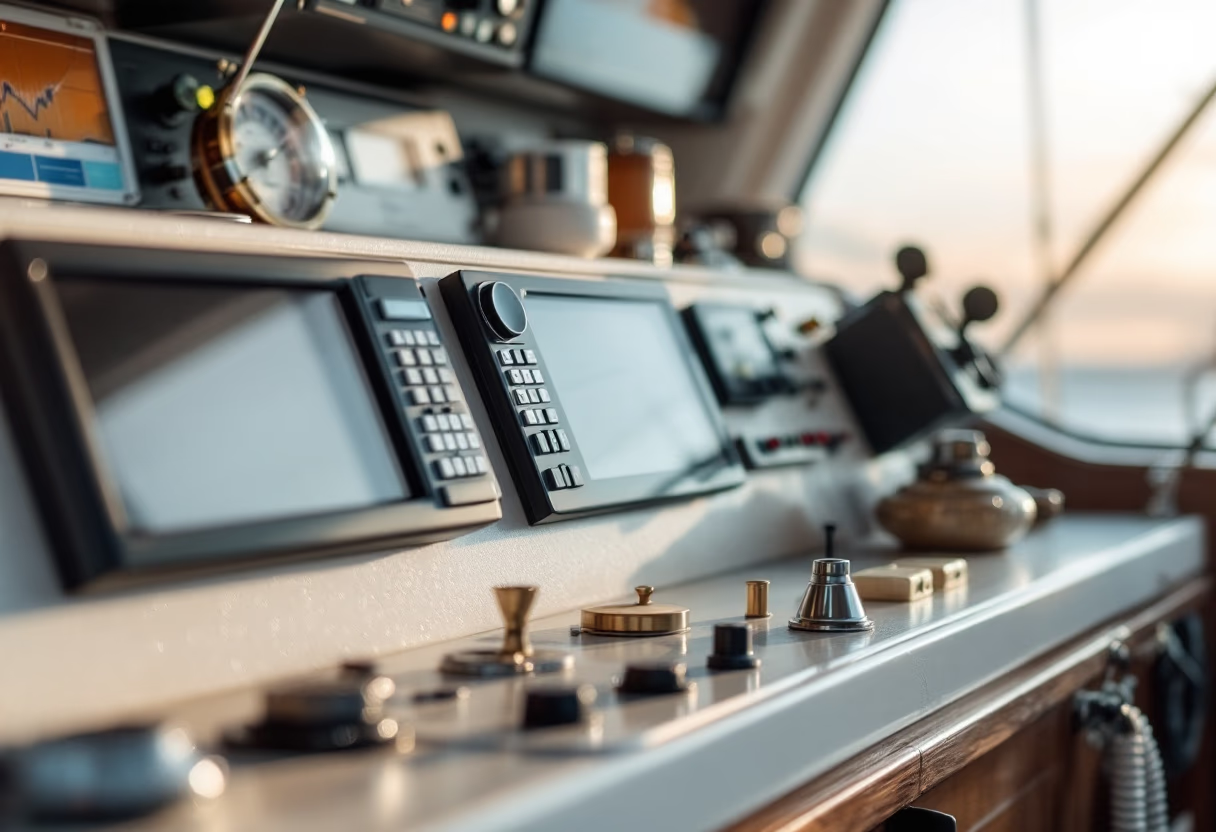
You've found the chartplotter you want. It's the right screen size, the right brand, has the chart subscription you prefer. Then someone at the dock says "but will it talk to your autopilot?" and suddenly you're down a rabbit hole of NMEA standards, backbone wiring, and compatibility matrices. This guide cuts through that.
NMEA 2000 (also written N2K) is a communication standard for marine electronics. It's a shared wiring backbone that runs through your boat -- a single cable system that lets compatible devices share data with each other. Before N2K, every device had its own dedicated wiring. Your GPS talked to your chartplotter via a serial NMEA 0183 cable. Your depth sensor had its own wire. Every new device meant more wiring, more connectors, more failure points. NMEA 2000 changed that. Connect any N2K-certified device to the backbone, and it can share its data with every other device on the network.
The N2K backbone is a single cable with a power connection at one end. Devices connect to it via T-connectors and shorter drop cables. Maximum devices: 50 LEN (Load Equivalency Number) units per network. Most devices are 1 LEN; some displays are 2-4 LEN. Maximum backbone length: 100 meters. Drop cable length: maximum 6 meters per device. Power the backbone from a single point -- power it from both ends and you'll have ground loop issues that are a nightmare to diagnose.
Physical compatibility is straightforward. The connector on a Garmin device is the same size and wiring as the connector on a Simrad device. They physically connect to the same backbone. Data compatibility is where it gets nuanced. NMEA 2000 devices communicate via Parameter Group Numbers (PGNs) -- data packets that describe different information types. A device needs to both transmit and receive the right PGNs to share data effectively. Proprietary network protocols are the real wrinkle. Garmin, Simrad, and Raymarine each run their own high-speed networks alongside N2K. Basic data sharing (GPS, depth, engine data) works fine across brands over N2K. High-bandwidth sharing (radar overlay, sonar, video) typically requires matching brands.
1. What's already on my N2K backbone? List the devices currently on it and their LEN values. 2. What data do I need shared between which devices? Be specific about your requirements. 3. Am I staying within one brand ecosystem or mixing? Matching your existing brand usually delivers more capability. 4. What's my current backbone capacity? If you're near 50 LEN, adding a device requires removing one or adding a second backbone segment. 5. Is my current cabling in good shape? Corroded connectors cause intermittent N2K failures that are difficult to diagnose.
Here's the scenario we see most often: someone buys a new chartplotter, connects it to their existing N2K backbone, and the autopilot stops working reliably. Or depth stops appearing on the chartplotter. Usually this is a firmware issue, a PGN conflict, or a physical wiring problem. The solution isn't more research after the fact -- it's a compatibility check before you buy, one that accounts for your specific boat, your existing devices, and the exact configuration you're trying to achieve. That's what we built HelmFit to do.
Check compatibility for your boat
NMEA 0183 is the older serial standard -- still common on legacy equipment. If you have older 0183-only equipment, you can bridge it to N2K via a gateway device (Digital Yacht, Actisense, and others make these). Expect to pay $100-$300. If you're building a fresh electronics setup, skip 0183 and go N2K-native.